http://www.orkut.com/FavoriteVideos.aspx?uid=3979242605811084234
Podem visitar meu ORKUT... estão lá em 11 partes um interessante estudo arqueológico a respeito do EXODO BÍBLICO...
Agora já disponibilizei o video deste importantíssimo estudo arqueológico sobre o Exodo na íntegra legendado em português...
Todos são benvindos...
Bíblia de Estudos e-Sword

domingo, 15 de junho de 2008


domingo, 8 de junho de 2008
Manuscritos do MAR MORTO
The Dead Sea Scrolls are a compilation of about 900 ancient documents that comprise the oldest known texts of the Old Testament and contain various psalms and stories not previously included in the Old Testament. They were discovered in eleven different caves on the shores of the Dead Sea in the mid-20th Century.
The scrolls contain text from the Hebrew Bible, including the last words of Joseph, Judah, Levi, Naphtali, and Amram (the father of Moses) and are the only known evidence of late Second Temple Jerusalem.
- Discovered between 1947 and 1956
- Believed to have been written between 200 B.C. and 68 C.E.
- Written on animal skins, papyrus and copper
- Written in Hebrew and Aramaic
- Scholars have identified the remains of 825 to 870 separate scrolls
- The Temple Scroll, found in Cave 11, is the longest scroll at 26.7 feet
- Provide an evolutionary link between Christianity and Judaism
The scrolls are believed to have been contained in a Jewish library that was hidden in the caves when the Roman army advanced on the rebel Jews.
Prophecies of Ezekiel, Jeremiah and Daniel that are missing from the Bible have been rediscovered in the scrolls. Previously unknown Psalms devoted to King David and Joshua, stories featuring Noah, Enoch and Abraham, including an explanation as to why God asked him to sacrifice his son, are also depicted in the scrolls.1.The Dead Sea Scrolls were discovered in eleven caves along the northwest shore of the Dead Sea between the years 1947 and 1956. The area is 13 miles east of Jerusalem and is 1300 feet below sea level. The mostly fragmented texts, are numbered according to the cave that they came out of. They have been called the greatest manuscript discovery of modern times. See a Dead Sea Scroll Jar.
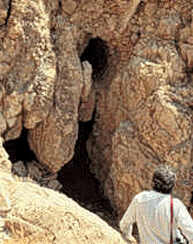 2. Only Caves 1 and 11 have produced relatively intact manuscripts. Discovered in 1952, Cave 4 produced the largest find. About 15,000 fragments from more than 500 manuscripts were found.
 3. In all, scholars have identified the remains of about 825 to 870 separate scrolls.
4. The Scrolls can be divided into two categories—biblical and non-biblical. Fragments of every book of the Hebrew canon (Old Testament) have been discovered except for the book of Esther.
5. There are now identified among the scrolls, 19 copies of the Book of Isaiah, 25 copies of Deuteronomy and 30 copies of the Psalms .
6. Prophecies by Ezekiel, Jeremiah and Daniel not found in the Bible are written in the Scrolls.
7. The Isaiah Scroll, found relatively intact, is 1000 years older than any previously known copy of Isaiah. In fact, the scrolls are the oldest group of Old Testament manuscripts ever found.
8. In the Scrolls are found never before seen psalms attributed to King David and Joshua.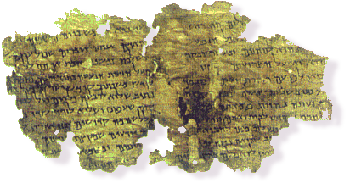 9.There are nonbiblical writings along the order of commentaries on the OT, paraphrases that expand on the Law, rule books of the community, war conduct, thanksgiving psalms, hymnic compositions, benedictions, liturgical texts, and sapiential (wisdom) writings.
10. The Scrolls are for the most part, written in Hebrew, but there are many written in Aramaic. Aramaic was the common language of the Jews of Palestine for the last two centuries B.C. and of the first two centuries A.D. The discovery of the Scrolls has greatly enhanced our knowledge of these two languages. In addition, there are a few texts written in Greek.
11. The Scrolls appear to be the library of a Jewish sect. The library was hidden away in caves around the outbreak of the First Jewish Revolt (A.D. 66-70) as the Roman army advanced against the rebel Jews.
12. Near the caves are the ancient ruins of Qumran. They were excavated in the early 1950's and appear to be connected with the scrolls.
13. The Dead Sea Scrolls were most likely written by the Essenes during the period from about 200 B.C. to 68 C.E./A.D. The Essenes are mentioned by Josephus and in a few other sources, but not in the New testament. The Essenes were a strict Torah observant, Messianic, apocalyptic, baptist, wilderness, new covenant Jewish sect. They were led by a priest they called the "Teacher of Righteousness," who was opposed and possibly killed by the establishment priesthood in Jerusalem.
14. The enemies of the Qumran community were called the "Sons of Darkness"; they called themselves the "Sons of Light," "the poor," and members of "the Way." They thought of themselves as "the holy ones," who lived in "the house of holiness," because "the Holy Spirit" dwelt with them.
15. The last words of Joseph, Judah, Levi, Naphtali, and Amram (the father of Moses) are written down in the Scrolls.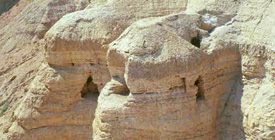 16. One of the most curious scrolls is the Copper Scroll. Discovered in Cave 3, this scroll records a list of 64 underground hiding places throughout the land of Israel. The deposits are to contain certain amounts of gold, silver, aromatics, and manuscripts. These are believed to be treasures from the Temple at Jerusalem, that were hidden away for safekeeping.
17. The Temple Scroll, found in Cave 11, is the longest scroll. Its present total length is 26.7 feet (8.148 meters). The overall length of the scroll must have been over 28 feet (8.75m).
18. The scrolls contain previously unknown stories about biblical figures such as Enoch, Abraham, and Noah. The story of Abraham includes an explanation why God asked Abraham to sacrifice his only son Isaac.
19. The scrolls are most commonly made of animal skins, but also papyrus and one of copper. They are written with a carbon-based ink, from right to left, using no punctuation except for an occasional paragraph indentation. In fact, in some cases, there are not even spaces between the words.
20. The Scrolls have revolutionized textual criticism of the Old Testament. Interestingly, now with manuscripts predating the medieval period, we find these texts in substantial agreement with the Masoretic text as well as widely variant forms.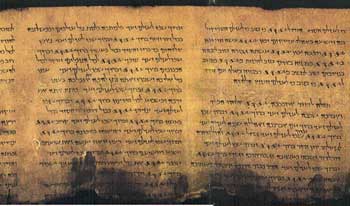 21. Some of the Dead Sea Scrolls actually appeared for sale on June 1, 1954 in the Wall Street Journal. The advertisement read — "The Four Dead Sea Scrolls: Biblical manuscripts dating back to at least 200 BC are for sale. This would be an ideal gift to an educational or religious institution by an individual or group. Box F206."
22. Although the Qumran community existed during the time of the ministry of Jesus, none of the Scrolls refer to Him, nor do they mention any of His follower's described in the New Testament.
23. The major intact texts, from Caves 1 & 11, were published by the late fifties and are now housed in the Shrine of the Book museum in Jerusalem.
24. Since the late fifties, about 40% of the Scrolls, mostly fragments from Cave 4, remained unpublished and were unaccessible. It wasn't until 1991, 44 years after the discovery of the first Scroll, after the pressure for publication mounted, that general access was made available to photographs of the Scrolls. In November of 1991 the photos were published by the Biblical Archaeological Society in a nonofficial edition; a computer reconstruction, based on a concordance, was announced; the Huntington Library pledged to open their microfilm files of all the scroll photographs.
25. The Dead Sea Scrolls enhance our knowledge of both Judaism and Christianity. They represent a non-rabbinic form of Judaism and provide a wealth of comparative material for New Testament scholars, including many important parallels to the Jesus movement. They show Christianity to be rooted in Judaism and have been called the evolutionary link between the two.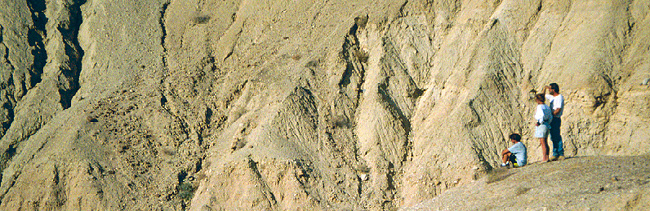 The rugged terrain of the Qumran area.
domingo, 25 de maio de 2008
Quem foi Pedro? Quem é CRISTO?
Pergunta do irmão Huss: (ORKUT – COMUNIDADE DR. ANÍBAL PEREIRA DOS REIS).
Irmão Heber, eu sou membro da sua comunidade sobre o Dr. Aníbal!!
Estava conversando com um amigo católico, sobre quem seria a Petra de Mateus 16.18. Ele disse que o evangelho de MATEUS foi escrito no grego KOINÉ este grego não faz diferença entre as palavras PETROs e PETRA, DIFERENTEMENTE DO GREGO ATICO, no qual realmente existe esta diferença. E ainda acrescentou que nos primeiros séculos do cristianismo, estes dois termos eram sinônimos.
É verdade que o contexto da Palavra nada favorece a interpretação vaticana. Mas creio que esse argumento de que Petros é sinônimo de Petra no grego koiné é mais uma falsificação romana.
Vc poderia me explicar se isso de fato acontece?
http://www.orkut.com/Scrapbook.aspx
RESPOSTA AO IRMÃO HUSS: ... Meu irmão Huss... Uma grande benção a tua visita aqui... benvindo sempre... quanto a esta questão que o irmão coloca, em primeiro lugar, temos que ajudar as pessoas sobre a identidade de JESUS CRISTO, ELE é perfeitamente homem como as credenciais de Mateus e Lucas registram em sua genealogia(Mateus 1:1-17 e Lucas 3:23-38) e ELE é perfeitamente DEUS como nos apresenta o evangelista João (João 1:1-14). Somente Deus pode resolver a ofensa triplamente qualificada com que a humanidade ofendeu a Deus em Genesis 3.: a)dívida contraída, b)inimizade constituída e c)crime cometido. Para solucionar esta gravíssima situação e condição humana, somente DEUS se tornando ser humano e assim sendo homem representa verdadeiramente o ser humano e sendo Deus, pode alcançar a Deus nos efeitos de sua ação. Desta forma se fez pessoa e realizou toda a obra necessária para a Redenção humana e proclamou na cruz: "Pai está consumado"(João 19:30). O próprio Jesus afirma ser o (único) caminho, verdade e vida (João 14;6), Paulo acrescenta "há um só Deus e um só Mediador entre Deus e os homens, Cristo Jesus homem"(1 Timóteo 2:5). Paulo ainda menciona em Filipenses 2:6-11 que “sendo Deus... tornando-se em semelhança de homens... obediente até a morte... Deus o exaltou sobremaneira e lhe deu um nome que está acima de todo nome. Para que ao nome de Jesus se dobre todo joelho , nos céus, na terra e debaixo da terra”. O autor da carta aos Hebreus afirma que “nestes últimos dias nos falou pelo Filho, a quem constituiu herdeiro de todas as coisas, pelo qual também fez o universo. Ele é o resplendor da glória e a expressa imagem do seu SER...”. Ler Mateus 16:13-20, nos enriquece muitíssimo ao perceber neste contexto quando Cristo está diante de um momento importantíssimo, ao perceber a verdadeira compreensão por parte dos discípulos de quem ELE É, (Mateus 16:16) está pronto então para dar continuidade ao seu sublime propósito de Redenção indo determinadamente para Jerusalém (Mateus 16:21-23), onde mesmo os discípulos e até Pedro, mesmo sendo importantíssimo na continuidade da obra que Deus estava realizando entre os seres humanos na formação de “sua igreja”(Mateus 16:18 ‘minha igreja’), no entanto, Pedro ainda mostrando a fragilidade típica do ser humano, foi usado por satanás no diálogo final com Cristo, revelando sua interpretação emocionalista da história. Jesus neste texto, observa que seus discípulos perceberam que ELE de fato É e os apóstolos são o elemento fundamental na formação de sua igreja, pois estão sendo chamados por Cristo para a composição dos fundamentos de Deus para que a “sua igreja” (de Cristo), tenha orientação adequada para ser edificada na Verdade (João 16:13; 17:17). Assim, Pedro é um líder tanto quanto todos os outros apóstolos, e são fundamentais enquanto apóstolos para que o fundamento da Escritura se forme para que a “sua igreja” (de Cristo), tenha esta Palavra da Verdade. Lucas menciona que a Igreja de Cristo persevera “na doutrina dos apóstolos”(Atos 2:42) e Paulo em Efésios 2:19-20 diz que “sois da família de Deus, edificados sobre o fundamento dos apóstolos e profetas, sendo ele mesmo, CRISTO JESUS, a pedra angular”, percebemos a referência do fundamento para que a revelação da Palavra de Deus fosse entregue aos seus pelos apóstolos e profetas, mas que a PEDRA PRINCIPAL é um só, CRISTO. Pedro afirma ter esta mesma compreensão “Chegando-vos para ELE, a pedra que vive... vós mesmos pedras que vivem... Pois isso está na Escritura: Eis que ponho em Sião uma pedra angular,... a pedra que os construtores rejeitaram, essa veio a ser a principal pedra, angular” (1 Pedro 2), Paulo novamente afirma ter a igreja de Cristo um único cabeça, CRISTO: “Cristo é o cabeça da igreja” (Efésios 5:23).
Assim temos a nitidez necessária no texto para sabermos quem é Cristo e quem somos nós neste propósito de Deus, quem é o Cabeça e quem são as pedras nesta construção sobre a PEDRA de Deus, quem é o cabeça, quem é o condutor e chefe da igreja, insubstituível e quem são as pessoas que após terem nascido de novo (João 1:12, 3:3, 1 Coríntios 5:17 e Efésios 2:1-10, tornando-se parte do corpo do SENHOR pela salvação e então batizados conforme SEU mandamento Mateus 28:18-20 e Atos 2:42-47, assim o Cabeça nunca foi tirado do corpo ou substituído por qualquer elemento humano nesta função.
Jesus afirma que Pedro é uma pessoa importante no início do cristianismo, como o foram também todos os apóstolos. Quando os apóstolos findaram suas vidas, seu ministério igualmente foi finalizado, não havia mais necessidade deste ministério apostólico que terminou com João e com seu livro que encerra as Escrituras de Deus: Apocalipse. Com a cláusula de encerramento em Apocalipse 22:18-19.
Pedro foi um líder, como todos os apóstolos foram e fundamentais para aquele momento da finalização do Texto de Deus e do início da igreja de Cristo. Mas uma teologia que afirma ser o texto de Mateus 16 um texto que aponta para um ser humano como um substituto de Cristo para conduzir a igreja de Cristo é um exercício de desconhecimento da identidade de Cristo, da obra de Deus, de quem ELE É, do texto, da história, da hermenêutica, da exegese e ainda um uso de anacronismo, pois a teologia que fez surgir esta idéia somente foi aparecer muito tempo após o cristianismo ter nascido com Cristo na Judéia, muitos séculos depois a teologia católica romana tendo sido formada com base fora das Escrituras de Deus e tendo se apoiado em fundamentos da tradição humana, sobre a base do antigo império romano onde o imperador era considerado deus e tendo toda autoridade, com sua queda, assume por um exercício inteligente de transformismo uma fachada cristã, mas com fundamentos imperiais romanos, onde o imperador assume a autoridade suprema adquirindo o nome de bispo de Roma, título bem adequado à função administrativa exercida e uma vez tendo utilizado ou usurpado a nomenclatura e até a literatura cristã em meio a toda teologia de divindades anexas ao sistema de crenças, faz este exercício anacrônico, isto é, busca nas Escrituras algum possível momento em que de alguma forma, possa respaldar sua função no bispado como sendo bíblica e até de orientação do próprio Cristo. Uma vez estando em épocas onde o exame das Escrituras era reduzido, onde o povo era subjulgado pela imposição totalitária de um império pseudo-cristão, onde o sistema imperial aniquilava seus opositores, esta idéia teve seu ambiente assegurado para fazer-se incluir na mente dos povos. Mas sem qualquer veracidade a partir da própria Escritura de Deus.
Sim, há outro representante de Cristo, perante o ser humano, para que permaneça com o ser humano até Sua Vinda, é o próprio Deus, na Pessoa do Espírito Santo, prometido por Jesus profeticamente (Ler João 14, 15, 16).
Qualquer tentativa de alterar O fundamento, deslocar a ROCHA, o oficio exclusivo do Cabeça da igreja, que é Cristo, é incorrer no que caracteriza um falso profeta (Mates 24).
As Escrituras são claras e óbvias, o ser humano diante da Palavra de Deus, pode optar, pelas Escrituras de Deus ou por suas preferências.
Deus abençoe a todos...
Heber
Orkut: Heber Zenun
Skype: hbrznn
Assinar:
Postagens (Atom)